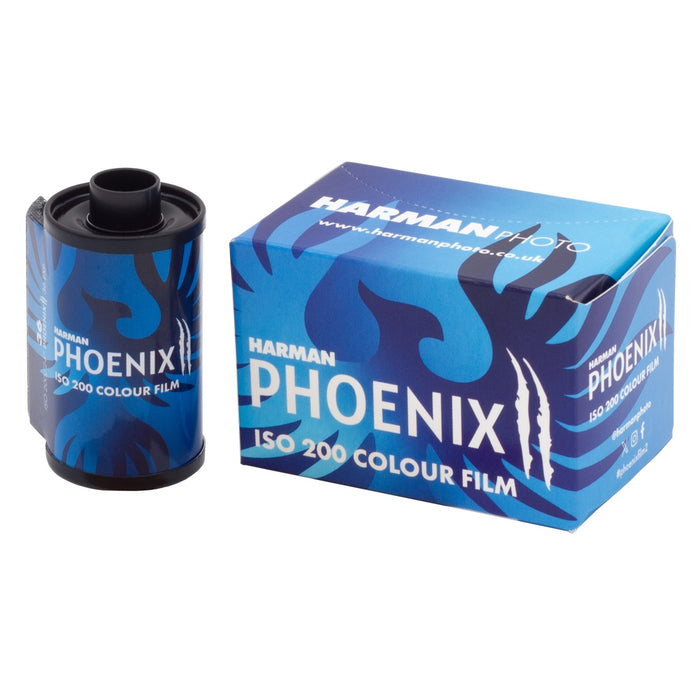
Harman Phoenix II: What’s Changed from the Original Film?
bu Joe Duggan
Harman’s second version of its cult colour film
Over the last couple of years, Harman has given film photographers two new colour films, an exciting development at a time when genuinely new emulsions are still relatively rare. Following the success of the original Phoenix, there has been plenty of interest in what Harman would change for its second version.
How did the original Harman Phoenix look?
If you shot the first Phoenix, you will know that it was not a conventional colour film. It was warm, full of halation and grain, and capable of unpredictable results, sometimes even between frames of the same subject. Processing labs were not always sure how best to scan it, and plenty of online guides appeared to help photographers get the look they wanted.
Finer grain and more natural colour
Harman Phoenix II feels much more refined. It produces less prominent grain and a more true-to-life colour palette, while retaining the warmth and highlight halation that made the original Harman Phoenix so distinctive. The film still has a recognisable character, but it is easier to work with and gives more predictable results.
Improved dynamic range
One of the biggest improvements in Harman Phoenix II is its dynamic range. The original film could struggle with high-contrast scenes, with highlights and shadows losing detail quite quickly. Phoenix II handles this much better, allowing more detail to remain visible across the frame.
This is particularly noticeable in busy scenes with both bright sunlight and deep shade. Detail remains visible in the lighter and darker areas without the image becoming muddy. That makes Phoenix II a more forgiving colour film to shoot, while preserving some of the distinctive character that made the original so popular.
Why Phoenix II’s lo-fi character still matters
For some photographers, the lo-fi quality is exactly why they will choose Phoenix II. Films at the more polished end of the market can deliver very fine grain and wide dynamic range, but their consistency may feel a little too restrained when you want something less predictable.
Phoenix II reminds me of the early days of film’s comeback, when photographers used plastic-lens Holga cameras and cross-processed film to create unusual colour. The results felt completely different from the digital point-and-shoot cameras that most people were using at the time. Phoenix II brings some of that experimental spirit into a more manageable film.
Hopefully, the interest in and success of Phoenix II will encourage Harman to continue developing this range of colour films.
What ISO should you use for Harman Phoenix II?
There are several approaches to exposing Harman Phoenix II. I shot this roll at ISO 100 to give it as much light as possible, as the meter and shutter speeds on my older camera may not always be completely accurate. As a practical starting point:
ISO 125–160: A useful choice for general daylight, helping to open the shadows while retaining rich mid-tones.
ISO 200 (box speed): Suitable for bright, flat or evenly lit open daylight, although you should keep an eye on dense shadows.
ISO 100: A good option in heavy shade or overcast conditions. Take care around bright highlights, as too much exposure can shift colour or lose highlight detail.
These are starting points rather than strict rules. Your camera meter, processing and scanning workflow can all influence the final result, so Phoenix II still rewards a little experimentation.
Camera and scanning setup
Every photograph in this article was shot on a Nikon F3 with a 50mm f/1.8 lens. The negatives were scanned using the VALOI easy35 v2 Film Scanner Main Kit, a compact camera-scanning solution for digitising 35mm film at home.
More Harman Phoenix II sample images
Is Harman Phoenix II worth trying?
Phoenix II is a clear step forward from the original. Its finer grain, more natural colour and improved dynamic range make it easier to use, without removing the warmth, halation and experimental feel that gave Phoenix its identity.
If you enjoy colour film with a distinctive look, or want an alternative to cleaner, more conventional emulsions, Harman Phoenix II is well worth putting through your camera.
Ready to try Harman Phoenix II? Choose from 35mm 24-exposure, 35mm 36-exposure and 120 roll film options to bring its warm colour, distinctive halation and creative character to your next shoot.
Photographer and educator Tom Warland puts a varied selection of darkroom papers to the test, comparing everything from everyday RC and warmtone fibre papers to coloured, bamboo and direct-positive materials. Watch the video to see how each paper affects the character of the finished print.
Join Firstcall Photo, The Flash Centre and Negative Supply at TFC Birmingham on the 23rd and 24th September for free film-scanning demos, expert advice, exclusive offers and free film.